
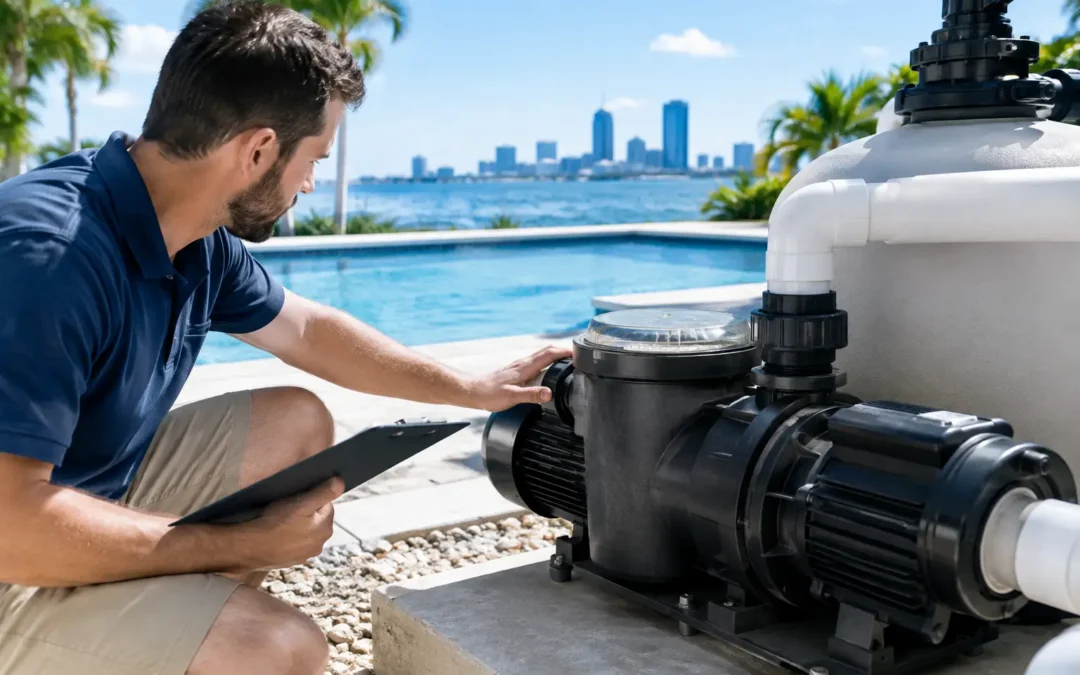
A pool pump that is too small can leave water dull, circulation weak, and equipment working harder than it should. One that is too large may cost more to operate, create excess noise, and push water through the filter faster than the system was designed to handle. For Jacksonville homeowners, learning how to size pool pump equipment starts with one practical goal: move the right amount of water through the entire pool system at the right speed.
Pump sizing is not simply a matter of choosing the highest horsepower number. The right selection depends on your pool’s water volume, plumbing layout, filter, sanitation equipment, water features, and the resistance created as water travels through the system. A properly designed circulation system delivers cleaner water, better equipment performance, and a more enjoyable backyard experience.
Start With Your Pool’s Water Volume
Every pump-sizing calculation begins with the number of gallons in the pool. This figure determines how much water the equipment needs to circulate during a normal filtration cycle. Most residential pools are designed around an eight-hour turnover rate, meaning the pump should be capable of moving the full pool volume through the filtration system within about eight hours.
For a rectangular pool, multiply length by width by average depth, then multiply that result by 7.48. For example, a pool that is 30 feet long, 15 feet wide, and has an average depth of 5 feet holds approximately 16,830 gallons:
`30 x 15 x 5 x 7.48 = 16,830 gallons`
Freeform pools, pools with tanning ledges, beach entries, deep ends, or raised spas require a more detailed calculation. The shape can make a significant difference, especially in a custom design where depths vary. A professional builder can calculate volume accurately from the construction plan rather than relying on a rough estimate.
Calculate the Required Flow Rate
Once you know the pool volume, divide it by the desired turnover time in minutes. An eight-hour turnover equals 480 minutes. Using the 16,830-gallon example above:
`16,830 gallons ÷ 480 minutes = 35 gallons per minute`
That pool needs a circulation system that can deliver roughly 35 gallons per minute, often abbreviated as GPM, under real operating conditions. This is the flow target, not yet the pump size.
Some homeowners assume a faster turnover is always better. It is not necessarily. Faster water movement can raise energy use and may exceed the ideal flow range for the filter, heater, chlorinator, or plumbing. The goal is dependable circulation that matches the complete system, not maximum speed at all times.
Why Horsepower Alone Does Not Size a Pool Pump
Horsepower is useful, but it does not tell the whole story. Two pumps with the same horsepower can produce different flow rates because their motors, impellers, and hydraulic designs differ. More importantly, a pump’s actual output changes based on total dynamic head, or TDH.
TDH is the resistance the pump must overcome to move water. Every pipe run, elbow, valve, filter, heater, cleaner line, and water feature creates some resistance. A simple pool with short, properly sized plumbing has lower resistance than a pool with a raised spa, multiple deck jets, a waterfall, and equipment located far from the pool.
This is why experienced pool professionals use a pump performance curve. The curve shows how many gallons per minute a specific pump can deliver at different levels of resistance. The selected pump must meet the required GPM at the system’s estimated TDH, not just on a product label.
Account for Your Entire Equipment Pad
A pump works as part of a complete circulation system. During a new pool build or equipment renovation, each component should be evaluated together. A pump that looks right on paper can become the wrong choice if the filter, plumbing, or added features are not considered.
Pay close attention to these factors:
- Filter capacity: Cartridge, sand, and DE filters each have recommended flow ranges. Excessive flow can reduce filtration quality or place unnecessary strain on the equipment.
- Plumbing size and distance: Larger plumbing generally reduces resistance. Long pipe runs, undersized lines, and numerous turns increase TDH.
- Heaters and sanitizers: Gas heaters, heat pumps, salt systems, and UV or ozone equipment may have minimum or maximum flow requirements.
- Water features: Spillways, sheer descents, bubblers, deck jets, and waterfalls may need additional flow beyond standard filtration.
- Attached spas: A spa often requires a separate higher-flow mode for effective jets and heating, while the pool itself may operate efficiently at a lower speed.
For a feature-rich custom pool, it is common to use different pump speeds or separate pumps for different jobs. That approach provides better control than trying to make one oversized pump handle every function all day.
Variable-Speed Pumps Are Usually the Smart Choice
For most modern residential pools, a variable-speed pump is the preferred solution. Instead of operating at one fixed speed, it can run slowly for everyday filtration and increase speed only when the spa, water features, vacuum, or heater need more flow.
This matters because lower speeds can dramatically reduce energy consumption. A variable-speed pump can also run longer at a gentle, quiet pace, which often improves surface skimming and overall water circulation. In Northeast Florida, where pools are used for much of the year, those efficiency gains can add up.
The trade-off is a higher initial investment and the need for proper programming. A variable-speed unit should be set according to your pool’s actual circulation needs, not left at a high speed out of convenience. The right schedule will depend on pool size, bather load, seasonal debris, sanitation method, and whether the pool includes a spa or water features.
How to Size a Pool Pump for Features and Upgrades
Equipment upgrades are an ideal time to revisit pump sizing. An older single-speed pump may have been selected before a salt system, heater, automatic cleaner, or water feature was added. Likewise, a pool renovation that includes a raised spa, new plumbing, or upgraded filtration can change the hydraulic needs of the entire system.
A waterfall may require a dedicated booster pump if you want a strong visual effect without forcing the main circulation pump to run at a costly high speed. Spa therapy jets often need their own pump for the same reason. Separating these functions can make the pool quieter and more efficient during everyday operation.
For pools with automation, the pump programming should reflect how the backyard is actually used. A family may want low-speed filtration through the day, a scheduled skimming period when leaves are most active, and a higher-speed setting before an evening swim. When equipment is sized and programmed correctly, the system supports the lifestyle of the home instead of demanding constant attention.
Common Pool Pump Sizing Mistakes
The most frequent mistake is selecting a pump based only on horsepower or the size of the previous pump. Older equipment may have been oversized from the start, and replacing it with the same rating can continue the problem. A pump should be matched to the current system, especially after renovations or additions.
Another mistake is ignoring the filter’s maximum flow rate. The pump, filter, heater, plumbing, and sanitizer need to work as a coordinated system. Installing a powerful pump without verifying those limits can lead to pressure problems, reduced efficiency, and premature equipment wear.
Homeowners also sometimes focus on the pool body while overlooking the spa, cleaner, and features. If a pump is sized only for basic filtration, the spa may underperform or the waterfall may look weak. If it is sized for every feature running at once, standard filtration may cost more than necessary. Variable-speed operation and dedicated feature pumps solve this balance in many cases.
When to Bring in a Pool Professional
A basic gallon calculation is useful, but it cannot replace a full hydraulic review. Professional sizing is especially valuable for custom pools, large pools, complex plumbing, elevated spas, major renovations, or equipment pads that are located a long distance from the water.
At Bonafide Custom Pools, equipment recommendations are considered alongside the pool design, finish selections, water features, and long-term performance goals. That helps homeowners avoid a common renovation regret: investing in a beautiful new pool surface or upgraded backyard features while leaving the circulation system undersized, inefficient, or mismatched.
The right pool pump should fade into the background. It should keep water moving, operate quietly, support the features you enjoy, and protect the investment you have made in your backyard. Before choosing a model, make sure the decision is based on actual water volume and system hydraulics – not a guess at horsepower.